THOMSON CFS THALES TH-477 Csf Radio Tube Transmitter Vapor 50 Cooled Triode
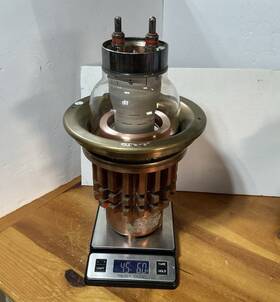
( Brand: Thomson Cfs Thales ), ( Manufacturer Part Number: TH-477 ), ( Type: Electron Tube ), ( Unit Type: Unit ), ( Country Of Origin: France )
Review THOMSON CFS THALES csf 50 Watt Radio Tube Transmitter Vapor Cooled Triode
The **Thomson-CSF Thales TH-477 (Thomson-CSF 50 Radio Tube Transmitter Vapor-Cooled Triode)** is a rare and highly specialized piece of vintage radiofrequency engineering, designed for high-power, long-distance communication applications during the mid-20th century. As a **vapor-cooled triode**, this transmitter tube represents a pinnacle of early radio technology, combining robust construction with advanced cooling mechanisms to handle the immense thermal loads generated during high-frequency transmission. Built by **Thomson-CSF** a French aerospace and defense electronics company known for its contributions to military and aviation communications the TH-477 was likely intended for use in naval, military, or high-power broadcasting systems where reliability and efficiency were paramount.
Physically, the TH-477 is an imposing component, constructed with heavy-duty materials to withstand the extreme conditions of continuous operation. Its **vapor-cooling system** a sophisticated alternative to traditional air or water cooling utilizes a closed-loop circulation of a dielectric fluid (such as silicone or a mineral oil-based coolant) to dissipate heat generated by the filament and anode. This method was particularly advantageous in confined or mobile environments where conventional cooling methods might be impractical. The tube s **triode configuration** featuring a control grid, cathode, and anode allows for precise modulation of the electron stream, enabling high-power amplification of radiofrequency signals with minimal distortion, a critical feature for clear long-range transmission.
The TH-477 was likely designed to operate within the **shortwave or high-frequency (HF) bands**, making it suitable for military command networks, naval communications, or even experimental broadcasting applications. Its high power output capabilities suggest it could drive antennas with significant range, potentially reaching thousands of kilometers under ideal conditions. The tube s construction reflects the engineering standards of its era, with **ceramic or metal seals** to maintain vacuum integrity, **heavy-duty electrodes** to resist arcing, and **robust mounting hardware** to ensure stability during operation. While such tubes are now obsolete in modern electronics replaced by solid-state components the TH-477 remains a fascinating artifact of a time when vacuum tubes dominated high-power transmission technology.
For collectors, historians of technology, or enthusiasts of vintage radio equipment, the TH-477 holds significant appeal. Its **military-grade specifications**, combined with its unique vapor-cooling system, make it a standout example of mid-century radio engineering. However, due to its age and specialized nature, operating or restoring one requires expertise in high-voltage electronics, vacuum tube technology, and cooling system maintenance. As a relic of an era when radio waves carried the weight of global communication, the Thomson-CSF TH-477 stands as a testament to the ingenuity of early electronic pioneers.
### **Pros and Cons of Buying a Thomson CSF Thales TH-477 (Thomson-CSF 50 Radio Tube Transmitter, Vapor-Cooled Triode)**
#### **Pros**
1. **Historical and Technical Significance**
The TH-477 is a high-power vacuum tube transmitter developed for military and naval applications, particularly in early radar and radio systems. Its vapor-cooled triode design was advanced for its time, offering reliability in demanding environments. Collectors and enthusiasts value it for its engineering heritage, especially in Cold War-era communications and radar technology.
2. **High Power Output**
As a 50-kilowatt transmitter tube, it was designed for long-range transmission, making it suitable for military use in radar, navigation, or secure communications. This power output remains impressive by historical standards, though modern solid-state alternatives have largely replaced such tubes.
3. **Durability and Robustness**
Vapor-cooled triodes were engineered for harsh conditions, including high ambient temperatures and mechanical stress. The TH-477 s construction suggests it was built to withstand prolonged operation under heavy loads, which could be advantageous for restoration or experimental projects.
4. **Collectible and Niche Market Appeal**
Due to its rarity and historical context, the TH-477 holds value among ham radio operators, military electronics collectors, and vintage technology enthusiasts. Some may seek it for display, research, or as a part of a curated collection of obsolete military hardware.
5. **Potential for Restoration and Educational Use**
For those with technical expertise, restoring and testing such a tube could be an educational project. It offers insights into early electronic engineering, vacuum tube physics, and high-power transmission systems. Universities or technical schools might find it useful for demonstrations.
---
#### **Cons**
1. **Extreme Age and Wear**
The TH-477 is likely decades old, potentially suffering from degradation in materials, insulation, or internal components. Vacuum tubes of this era often develop leaks, cracked glass, or degraded filaments over time, making them unreliable without extensive restoration work.
2. **High Maintenance and Repair Challenges**
Replacing or repairing individual components (e.g., filaments, cooling systems, or internal wiring) can be difficult due to obsolescence. Parts may no longer be manufactured, and sourcing replacements could require specialized suppliers or reverse-engineering efforts.
3. **Power and Cooling Requirements**
A 50-kW transmitter demands significant electrical power and sophisticated cooling systems. Modern homes or garages may lack the infrastructure (e.g., heavy-duty wiring, dedicated generators, or industrial cooling) to safely operate such a device without risking electrical fires or damage.
4. **Safety Risks**
High-power vacuum tubes generate intense heat, electrical arcing, and potentially hazardous voltages. Improper handling could lead to burns, electrical shocks, or equipment damage. Safe operation requires expertise in high-voltage systems and proper shielding.
5. **Lack of Modern Compatibility**
The TH-477 was designed for analog, vacuum-tube-based systems. Modern radios, amplifiers, and control interfaces are digital and solid-state, making integration or practical use in contemporary setups nearly impossible without extensive modifications.
6. **High Acquisition and Restoration Costs**
Purchasing a TH-477 may require significant investment, especially if the tube is in poor condition. Restoration could involve labor-intensive work, including cleaning, sealing leaks, and replacing worn components costs that may outweigh its sentimental or functional value.
7. **Ethical and Legal Considerations**
If the tube was used in military applications, its acquisition might raise ethical questions, particularly if it was sourced from decommissioned systems or conflict zones. Additionally, some countries regulate the export or possession of vintage military hardware.
---
#### **Conclusion**
The Thomson CSF Thales TH-477 is a fascinating piece of engineering history, offering unique appeal to collectors, hobbyists, and technical enthusiasts. However, its practical utility today is limited by age, complexity, and the lack of modern infrastructure to support its operation. While it may serve as a museum-quality exhibit or a subject for educational projects, its high maintenance, safety risks, and cost make it a poor choice for most modern applications.
For those with deep technical knowledge, patience, and resources, restoring and operating such a tube could be a rewarding endeavor but it is not a practical purchase for casual users or those seeking functional radio equipment.
---
#### **Recommendation**
- **Buy only if:** You are a serious collector with expertise in vacuum tube restoration, have access to proper safety equipment, and are prepared for the extensive work required to bring it to operational condition. Alternatively, if you seek it purely for historical display or research purposes.
- **Avoid if:** You are looking for a functional radio transmitter, lack the technical skills or resources to restore it, or prioritize modern, reliable alternatives. In such cases, consider contemporary solid-state amplifiers or digital radios instead.
- **Alternatives:** For high-power transmission needs, modern linear amplifiers (e.g., solid-state or grid-driven tubes like the 4CX15000A) offer far greater reliability and ease of use. For historical interest, explore less complex or more accessible vintage tubes (e.g., 450B, 811A) that are easier to source and maintain.
Details:
This was in a large box with other tubes marked station pulled. AND DATA SPECS INCLUDED AS SCREENSHOTS ONLY no papers. THOMSON-CSF TH-477 Thales 50,000 Watt Radio Tube Transmitter Vapor Cooled Triode. Can't have a tube go out during broadcast of EMS so they were pulled, i've heard at 40 % and 50 deemed life hours.
THE THING TO REMEMBER WITH THIS TYPE TUBE AND BROADCASTING TUBES To be on the safe side THEY WERE PULLED LONG BEFORE THEIR OPERATING HOURS UP. Open to offers remember its FREE SHIPPING.
part #: th477 prices
- $36.94-$300.00
specifications tubesocketvintagego:
- brand: Thomson Cfs Thales
- mpn: Th-477
- type: Electron Tube
- unit type: Unit
- country of origin: France
seller tubesocketvintagego:
- # reviews: 8624
- rating: 100.0%
- city: Brunswick, Maryland
payments tubesocketvintagego:
- other
- credit card: Visa
- wallet: Apple-pay
general tubesocketvintagego:
- condition: Used
- Vintage Audio Video > Vintage Parts Accessories > Vintage Tubes Tube Sockets
shipping tubesocketvintagego:
- carrier: USPS
- service: USPS Ground Advantage
- class: Standard
- cost: $0.00
- type: Fixed
- transit: 4-9 Days
returns tubesocketvintagego:
- policy: Returns Accepted
- method: Money back
- time: 30 Days
- paid by: Seller
offer tubesocketvintagego:
- quantity: 1
- availability: In Stock
- best offers: True
- sold: 0
- started: February 8, 2026
- options: Ship-to-home
Thomson Cfs Thales TH-477 Is Similar To:
- 4cx5000a-8170 Thomson Csf Tube Warranty (32.1% similar) This burn-in helps stabilize the internal operating parameters of tubes before measurements begin. 5FILAMENT cathode threaded tungsten voltage 5 volts current 75 amps capacitance grounded cathode input ,000 watts screen dissipation max. 1 pf cooling forced airbase special coaxial air socket SK-...(March 21st, 2019)
- 5j26 Cv3602 Jnt1-500w Th3061 Thomson-csf (25.4% similar) Winning bidder must wait till they receive shipping charges from me to them before paying for their item. Used Thomson 5J26 CV3602 JNT1-500W TH3061 l-band unable RF pulse power magnetising tube valve. Sold as is untested condition...(July 13th, 2017)
- Th331 Thomson Vintage Csf Television Transmitting Tetrode Tube (40.3% similar) The tube was made in france possibly between. This offer is for a vintage, rare Thomson csf transmitting tutored tube television transmission...(July 6th, 2018)
- Th347 Thomson-csf Transmitting Tetrode Tube (47.4% similar) The tube itself is in good condition. Used but has not been in use for sometime...(December 17th, 2016)
- Thomson-csf Th328 Thomson-csf Tube Silver Coating (51.1% similar) Needs rebuilding needs...(February 27th, 2025)
- Thomson Th15 1 Uhf Triode Tube Rs-1064c By Thales For Lptv Transmitter Untested (42.1% similar) I do not know the history on these but i've sold several of same type with no complaints. It has the original packing foam and box. Thomson now Thales developed a number of tubes like this specifically for uhf television translator / lepta service. Note: pics of box and tube may vary, all are in ...(December 5th, 2025)